Introduction
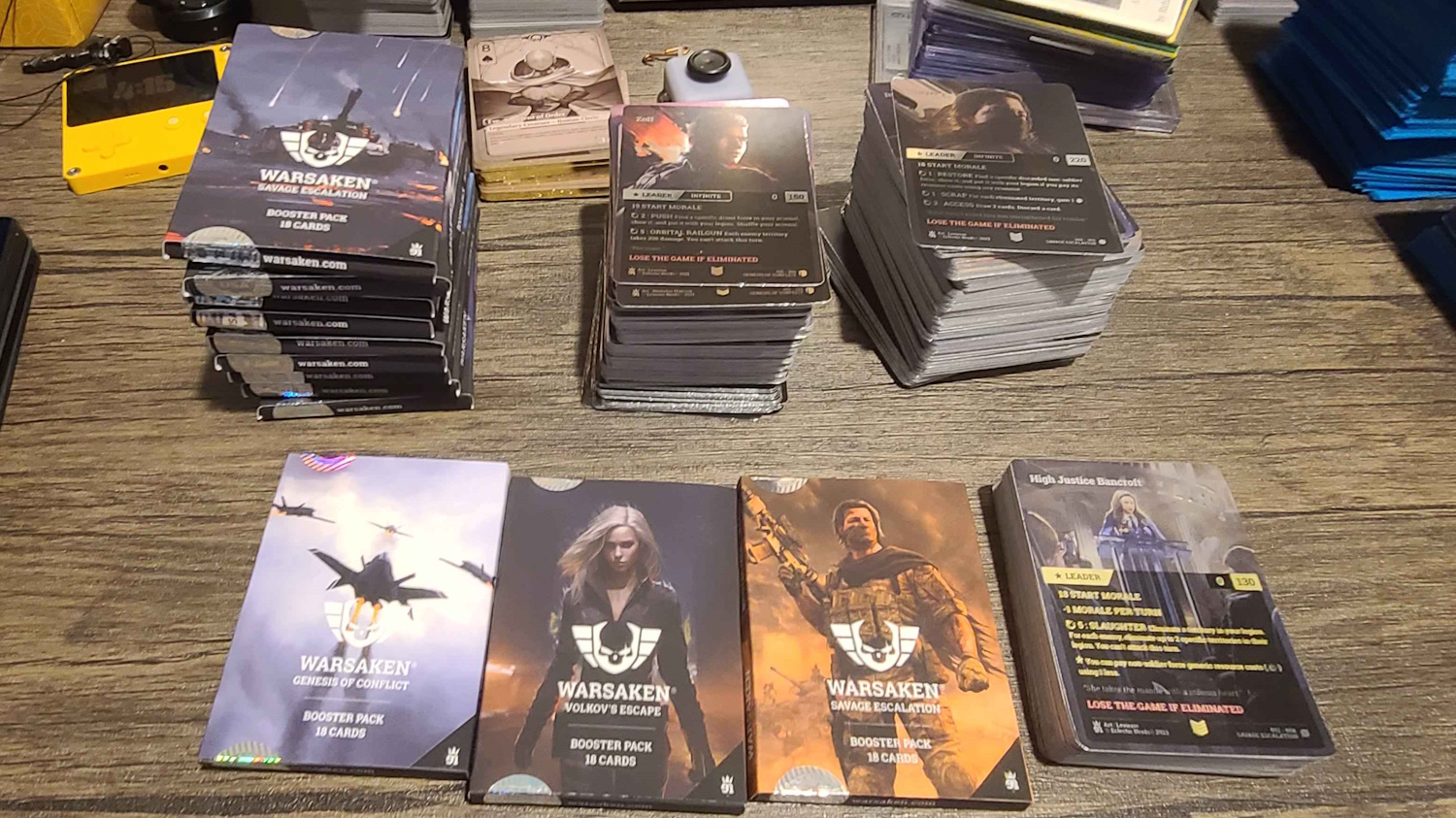
My work with Warsaken began in early 2022 when I was invited on as a game design contracter primarily for Savage Escalation (Set 002). I worked closely with two lead designers and other collaborators on over 240 unique cards, beginning with initial text drafts and discussions about set vision, refining mechanics for balance and to gel with Warsaken’s rules templating and typesetting options, working with about a dozen playtesters to collect empirical and subjective information, and working through unique design challenges as they arose up through the end of production.
I’ve written dozens of pages about the balance and competitive viability of Warsaken’s past and current designs, so go peruse those if you want my design insights on any particular cards. As well, Savage Escalation is now available digitally and physically!
Besides the game design work, I was also contracted for web development with Eclectic Nerds in 2022, which included improving mobile web app performance while in-game by +50%, designing and creating a chatbot and combat analysis tool, and building and submitting Progressive Web Apps for the Google Play and Windows app stores. Later in 2025, I built the Warsaken Card Designer from a rough JavaScript draft into a proper React app, which is now being used in production to create sets and cards, automatically format them with frames, symbols, and rules text, and export print-ready images and digital metadata. This has massively sped up production on new sets by automating a lot of manual Adobe InDesign work and hand-written JSON. As of writing, the small Set 003 and several promo cards have already been produced with it, and I expect it to be a key part in the large Set 004’s production.
Game Design Process Overview
Before I was approached about working on Warsaken, I had been working on my custom Magic: The Gathering designs and had written several dozen pages of analysis all about Set 001 and where I thought the competitive metagame would go and what archetypes would form. This document (despite being in dire need of editing) ended up being a significant resource for Discord community members looking to jump into Warsaken with a competitive bite, and that in conjunction with my custom Magic designs played a large part in my being brought on for contracted work for Warsaken. After I was hired on, I also continued writing about Set 002 once the set was finalized.
Starting work as a game design consultant for the first time, I began by sketching interesting card concepts, novel and derivative. Early in production we would simply discuss my sketches and add them to the set’s first draft piecemeal, discussing design considerations as we went. It was an approach that I found fluid and which matched my hobbyist experience that already required I juggle multiple disciplines. As production went along this process naturally got more complicated as we started considering the overall set vision and mapped out the boundaries of what we could and couldn’t do within Warsaken’s rules. Some examples of what we discussed include…
- Overall set composition including archetypes and themes we wanted or needed to support, and where the gaps needed to be filled. Summarized, this might look like “we want to lean into Wingmen as a glass cannon go-wide archetype, so let’s give the decks an attackable building that grabs a wingman from your deck every turn and puts it into play for as long as the building survives.”
- Ability rules text formatting for rules-lawyering and standardization and programmability purposes, for disambiguation and player comprehension and simplicity, and for the sake of rewording an ability to save a linebreak and showing off more art on the card (or multiple cards if the ability is reused).
- Comparing and contrasting and revising designs in accordance with the standards established in Set 001. e.g., “Soldiers cost between 0-4 resources (usually food), have 0-1 turn timers, and are statted no bigger than 40/40 in most cases.” Our findings from Set 002 playtesting would also often get wrapped up in these conversations and revisions, as we mapped out what precisely Warsaken was and where we could take it without disturbing the core fundamentals of the game.
- Player psychographic and aesthetic profiles, what their motivations are, and how to juggle them all across a set. That is, why certain players enjoy the game - they like big exciting plays, or like complex and creative decks, or are hypercompetitive and just want to win at any cost, or appreciate the mechanical craft of cards, or appreciate the art and world and aesthetics. Moreover, we discussed how and when to appeal to those players.
- The impact of introducing certain effects and cards to the game. We cannot unprint cards if they turn out to be a problem later. As a physical and digital trading card game, Warsaken doesn’t have the luxury of being able to do frequent functional card errata, and banning cards early in the game’s life is not an idea anyone takes pleasure in. Accordingly, we realized that certain designs put too many constraints on what we could do in the future - for instance, an early version of Denson Factory could put a tank force from your hand directly into play, which limited how good we could make certain tank forces in the future since we would know they could be cheated out much earlier than normal.

Sola Island Markets, the card most revised and discussed over the course of Set 002 development.
Throughout that process, we didn’t always agree on certain design decisions, but we said our pieces and committed and made future decisions according to what we had committed to do. I consider my time designing for Warsaken Set 002 to have been valuable teamwork experience and I’m quite happy with what we accomplished and how it plays. I had fun, and I hope whoever plays with the set has fun too!
Warsaken Card Designer
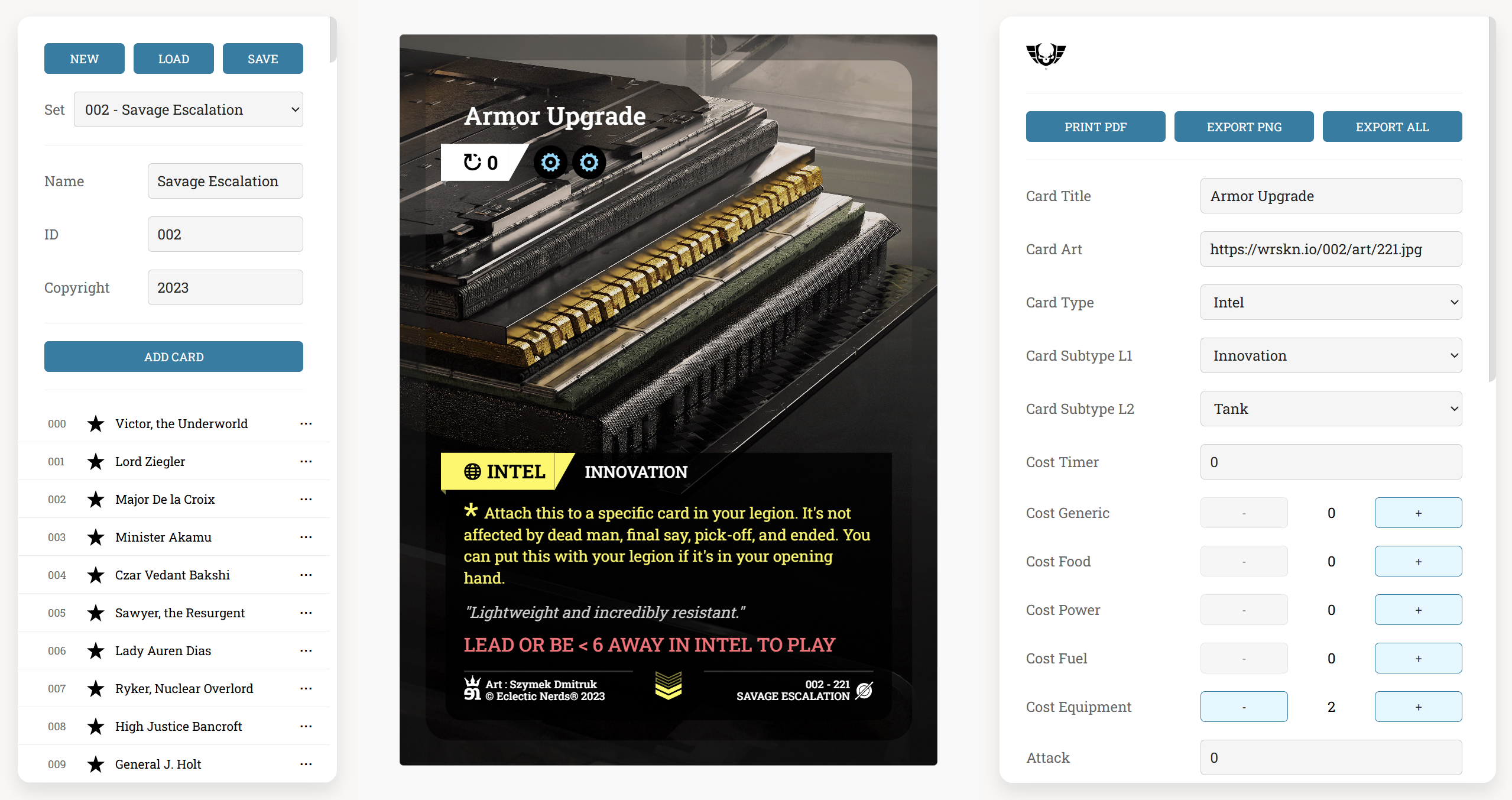
In 2025 I was contracted to build the Warsaken Card Designer, a React webapp that provides a user-friendly interface for building cards fit for digital publishing and physical printing, as a bespoke replacement for the previous workflow involving a lot of manual work in Adobe InDesign and hand-crafting JSON files. It contextually formats cards and changes frames based on card types and other attributes, and can import and export sets from the previous and new JSON schemas ready to be fed to an n8n API that handles Shopify publishing and other digital grunt work.