My experience with custom Magic: The Gathering design spans nearly six years as of writing. I have been playing actively since 2017, mostly focused on Draft and Commander/Brawl, with fits and spurts of involvement in 60-card constructed formats like Standard and Modern. I’ve also gleaned design insights from time invested in other collectible card games, namely Hearthstone and Legends of Runeterra, as well as a smattering of other card games like the Pokemon TCG, Slay the Spire, The Binding of Isaac: Four Souls, and Balatro. As well, during my Master’s program at DigiPen, I was taught and employed a lot of game design principles in my big grad student projects, with special mention to Characteristics of Games - one of the most enjoyable textbooks I’ve read - alongside my extracurricular study of Winning Ways for your Mathematical Plays. I’d also be remiss if I didn’t mention the many Magic design articles that have offered invaluable insight into the TCG production process.
I have owned the card design and production process from initial conception and many iterations thereafter, to character design and art direction, to playtesting and theorycrafting with many amazing Magic community members, and to copyediting and finalizing print files. This experience has not only been a fun and productive hobby for me, but also translated into my first professional game design work for Warsaken, where I worked alongside two designers and other contributors on over 240 unique cards for Set 002, from initial conception and set vision, through multiple iterations of playtesting and redesign, and into final digital and physical production. I also built the Warsaken Card Designer, which is now being used in production to create sets and cards, automatically format them with frames, symbols, and accurate rules text, and export print-ready images and digital metadata. This has massively sped up production on new sets by automating a lot of manual Adobe InDesign work and hand-written JSON. But I digress.
The cards in this article are the culmination of many formal and informal design lessons learned over the years. Most are designed top-down (starting with flavor before game mechanics), based on characters not originally intended to be on cards. Most of them are my characters that I wrote short biographies and visual descriptions for, and then commissioned artists to create references and other art for them. All artists are credited on my cards, and in art image filenames - my dearest thanks go out to everyone who’s worked with me over the years! Past that, I use Magic Set Editor to quickly sketch cards, Card Conjurer to format hi-res print-ready images, and MakePlayingCards.com to actually print them. I do not sell and do not profit from these - I make them for the love of the game.
Usha, the Showstopper
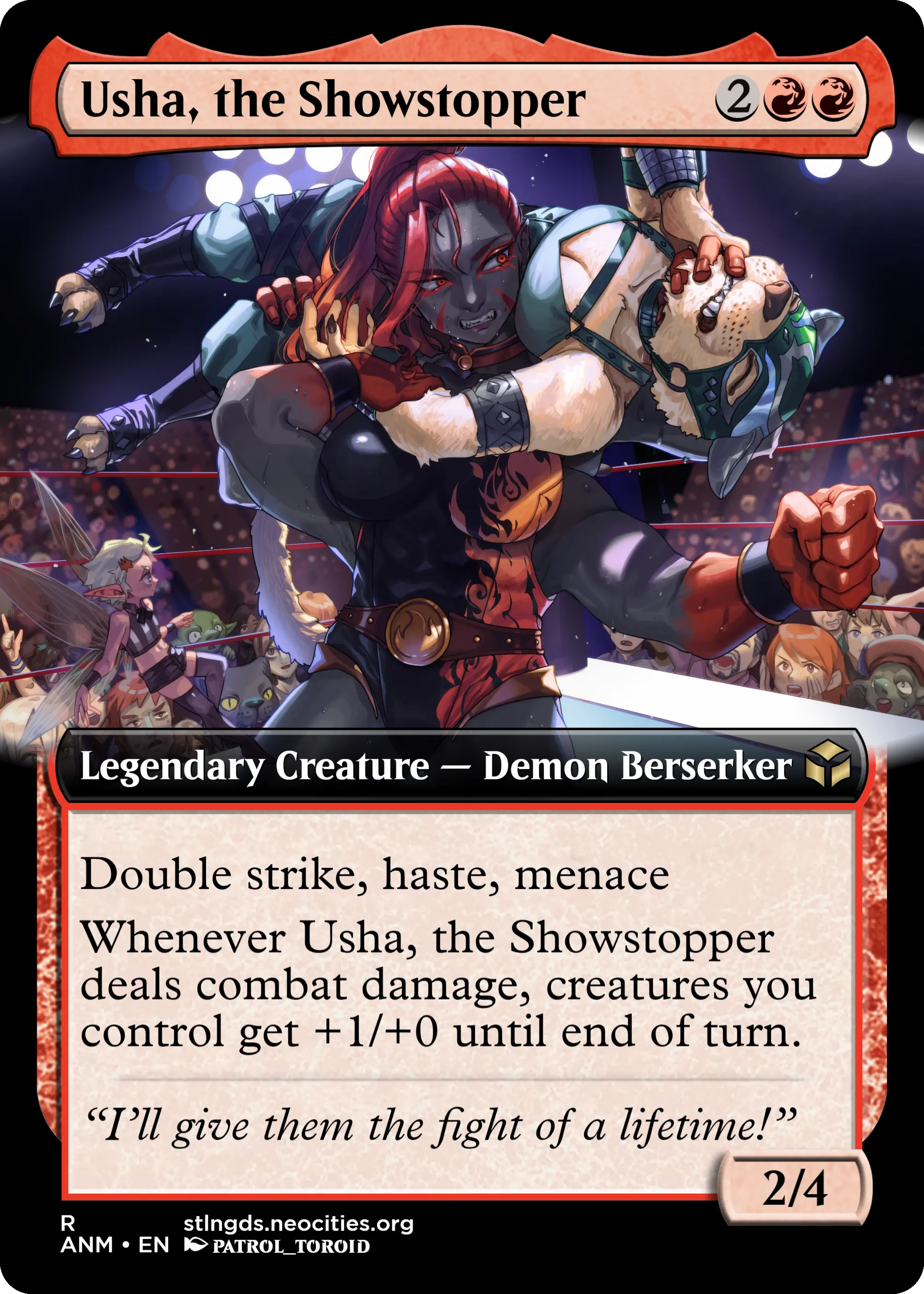
Usha is a professional wrestler who developed from a worldbuilding exercise where I designed the Infernal, a magically-modified human subspecies with four arms, high endurance, and shorter lifespans. Like with most of my characters, I boiled her down to a 1 page visual description and short biography, and worked with an artist to produce a visual reference sheet from that. I adore her visual design and the pro wrestling kayfabe, and want to keep her around for some future creative work. In this case, unlike how I usually work with artists, the card art was produced from a one-shot Skeb commission where the platform mandated that I provide reference images and a textual description of what I wanted, and then could not provide further input until the final piece was delivered. In this case, it turned out beautifully.
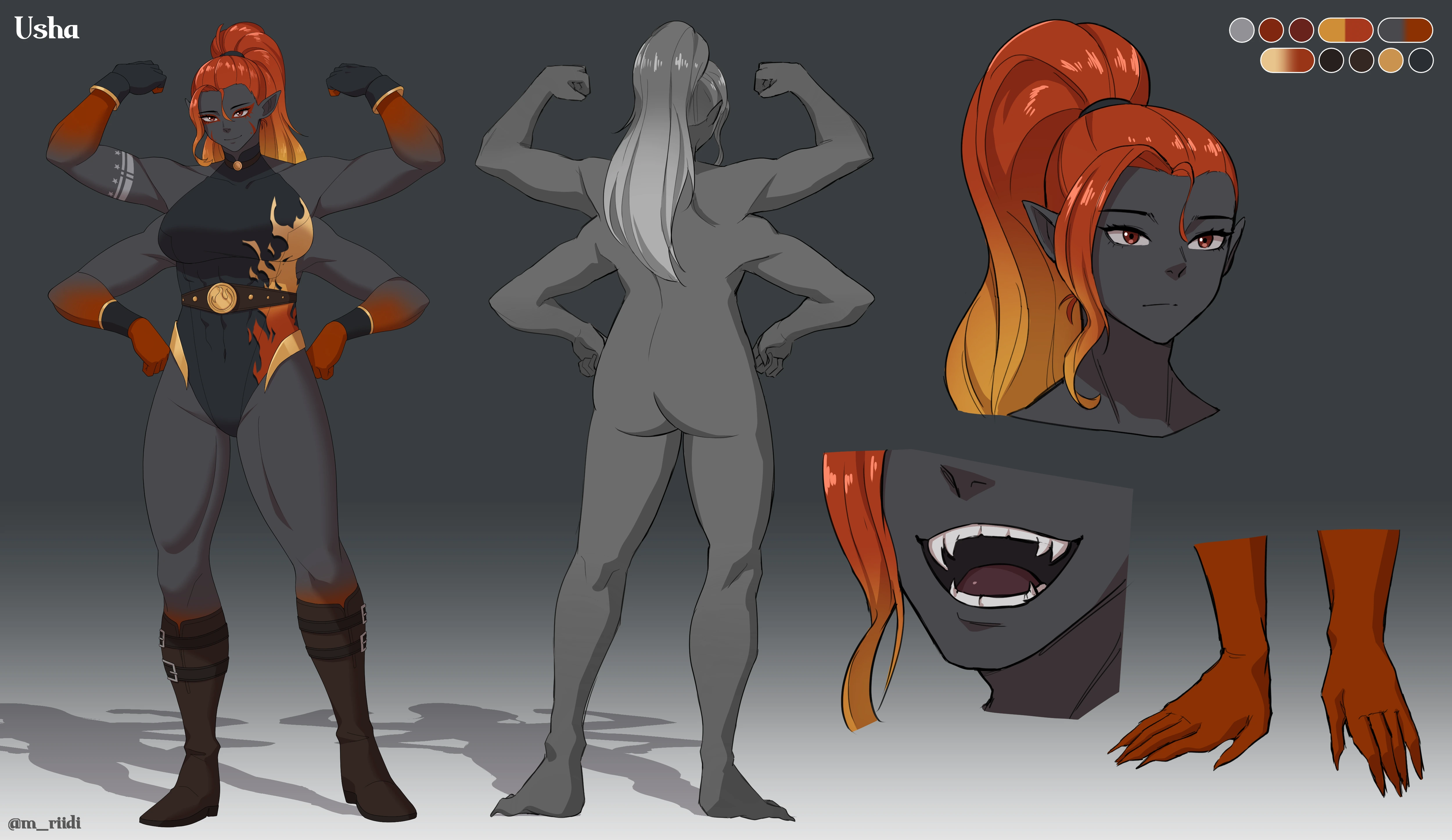
Usha's reference sheet, art by riidi.
This is a pretty simple but effective red rare intended to pay off with extra combat damage triggers from double strike (owing to her four arms) and additional combat phases. I envisioned the +1/+0 buff as her making her fans - your creatures - go wild whenever she lands a solid hit. I originally designed her with the intent of including her in my cube, but shortly after printing Usha I took my cube apart as it had grown too unmanageable due to its size and complexity and lack of interest from others, leaving the poor girl orphaned for now. I had also not intended for her to be printed with haste - I made a version without it out of fear that she was overtuned, and accidentally used the old one when printing - but then Knuckles the Echidna rolled in with very similar stats and abilities a year or two later, and I no longer felt as worried.
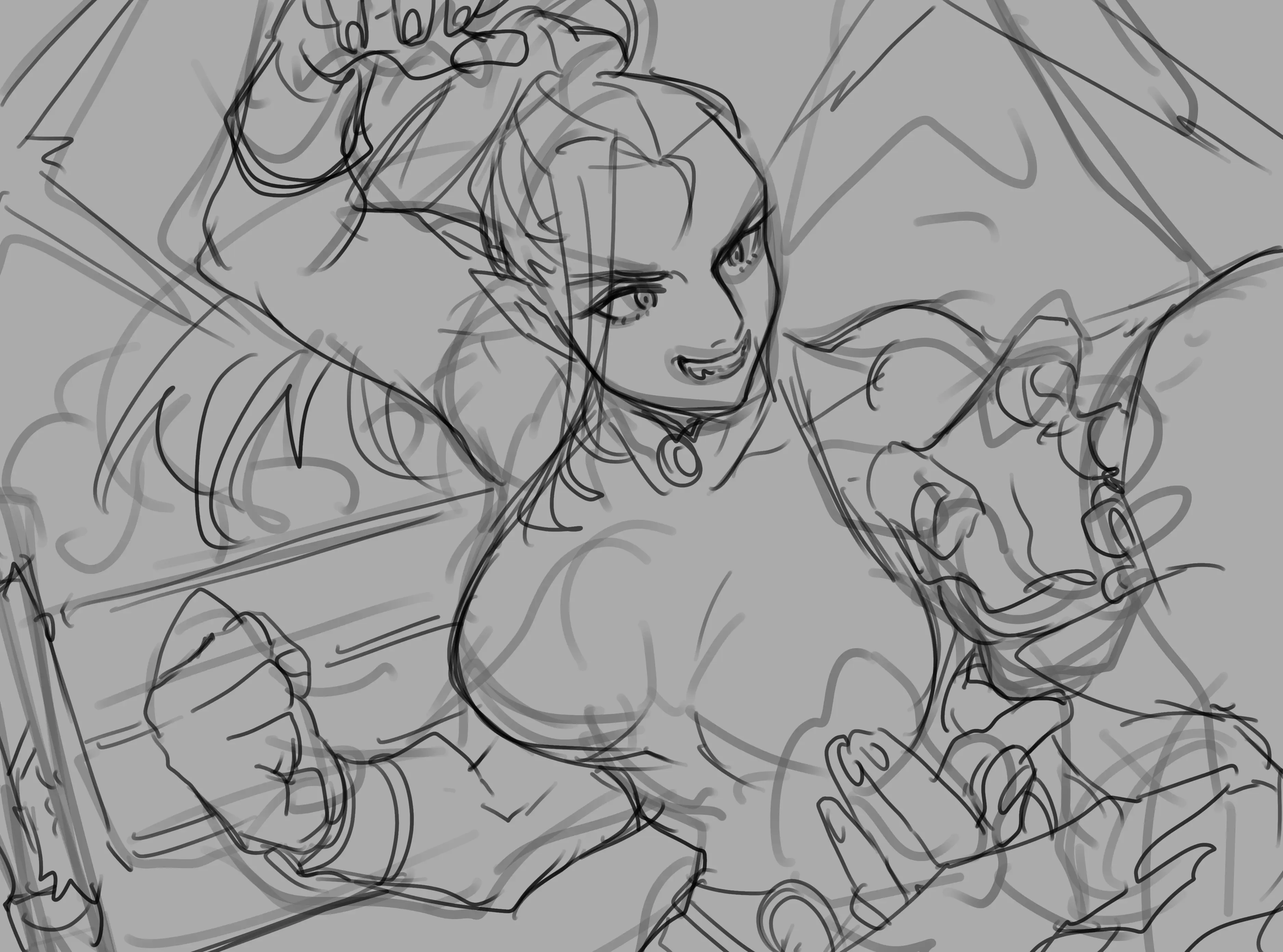
Alternate Usha sketch, art by patrol_toroid/hisayoshi.
Throw
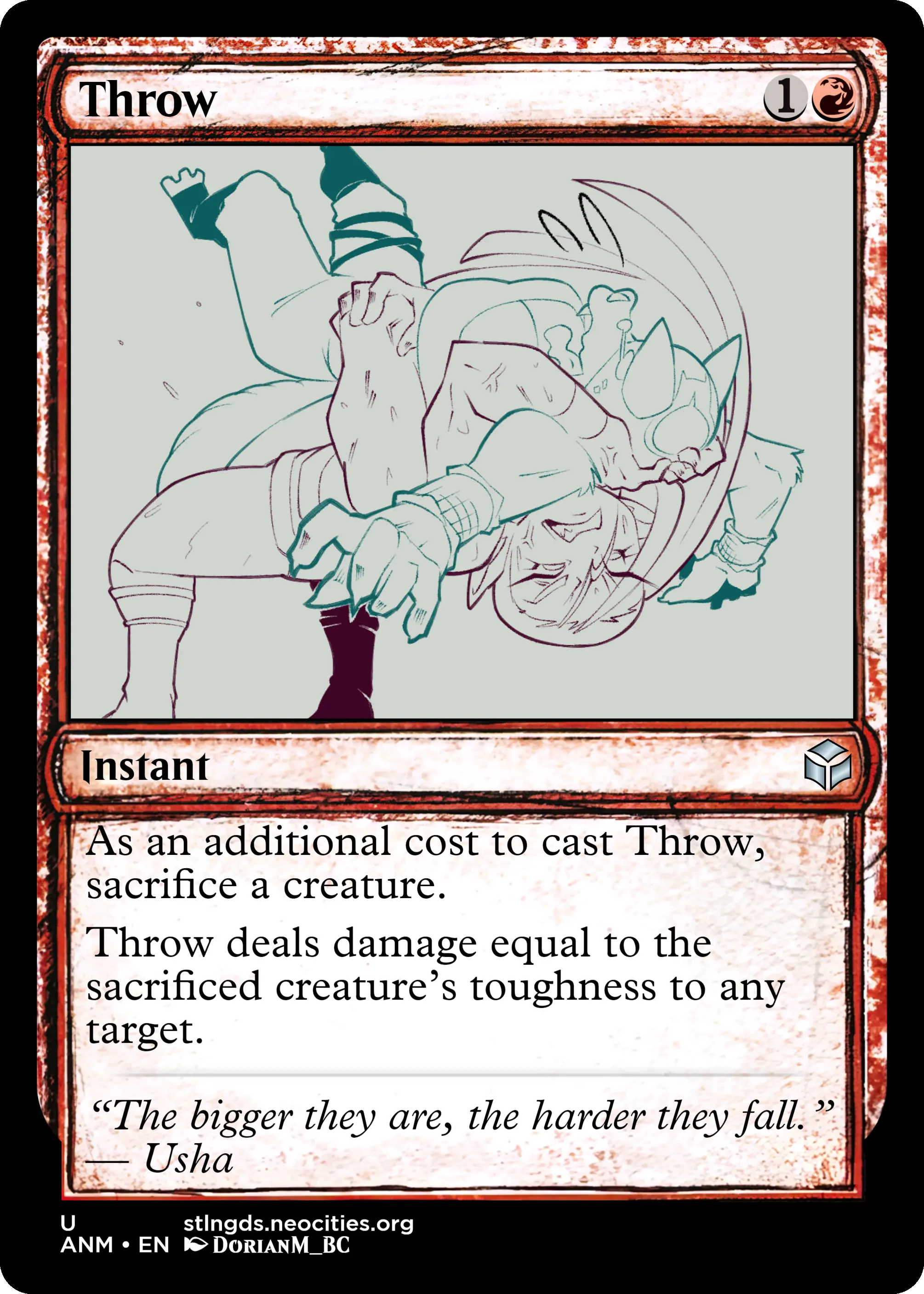
Toughness-based Fling is a concept I have personally thought about for awhile, partially because it seemed so simple, not terribly overpowered, and flavorful, and also because I had this sick art of Usha doing a four-armed suplex (a wrestling throw), and the parallel between the names Fling and Throw was cute. However, I have to acknowledge that R&D hasn’t opened the floodgates on this idea in the way they have with Fling, and for good reason. Power being used for damage is obvious and easy-to-balance in a way toughness-as-damage is not, especially in Red which has the least precedent for toughness-matters out of any color. Likewise, it could cause unforeseen and unwanted design restrictions on future cards that might otherwise be fine without Throw’s existence. I do not have such restrictions as a hobbyist designer and this card certainly isn’t unfair or unfun or even completely out-of-character for red, but if I were in a different position I would think a lot harder about how to introduce such an effect to Magic mechanical canon in a satisfying way that still respects color identity. Anyone else remember when red walls were a thing…?
Wampus, Prodigal Pilferer
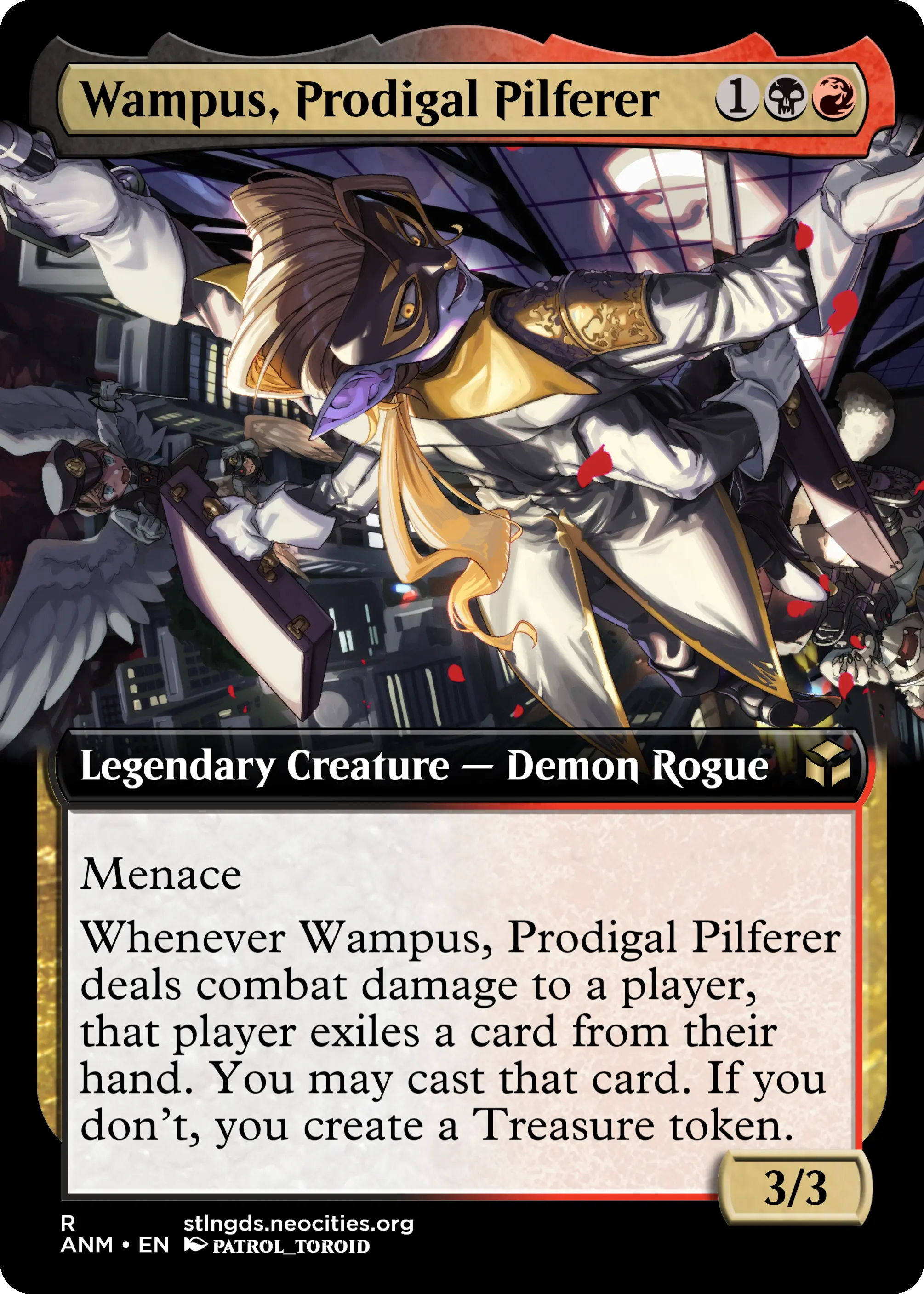
Wampus is the second Infernal character I designed - an affluent and ostentatious young businessman who moonlights as the cavernous city of Sulveria’s resident cat burglar extraordinaire. Accordingly, he takes cards from your opponents when he hits them which you can then either play or cash in for profit in the form of a Treasure token. This is mechanically riffing on Specters, a creature type full of evasive 3-4 mana creatures that force a discard when they deal combat damage to a player. There’s also a bit of Ragavan peeking through, albeit at a more reasonable (though still bar-and-eyebrow-raising) rate intended for use in my cube, much like Usha above and many of these other cards.
R&D generally does not print new “whenever this creature deals combat damage to a player, that player discards a card” effects anymore, likely because it’s an oppressive, chilling effect that is difficult to put an upper limit on and balance. That said, it’s also at least partially because they’ve switched to “whenever this creature attacks, each opponent discards a card” instead, as with Kefka, Court Mage and Aclazotz, Deepest Betrayal, albeit being on high-profile 5 mana legendary creatures. With that in mind, could Wampus be theoretically printed into Magic canon in the year 2025? Stranger things have happened, but by R&D’s standards today it might be a stretch at 3 mana. That aside though, I think there’s a lot of appeal to stealing your opponents’ cards, if the popularity of Gonti, Lord of Luxury among players and R&D is any indication.
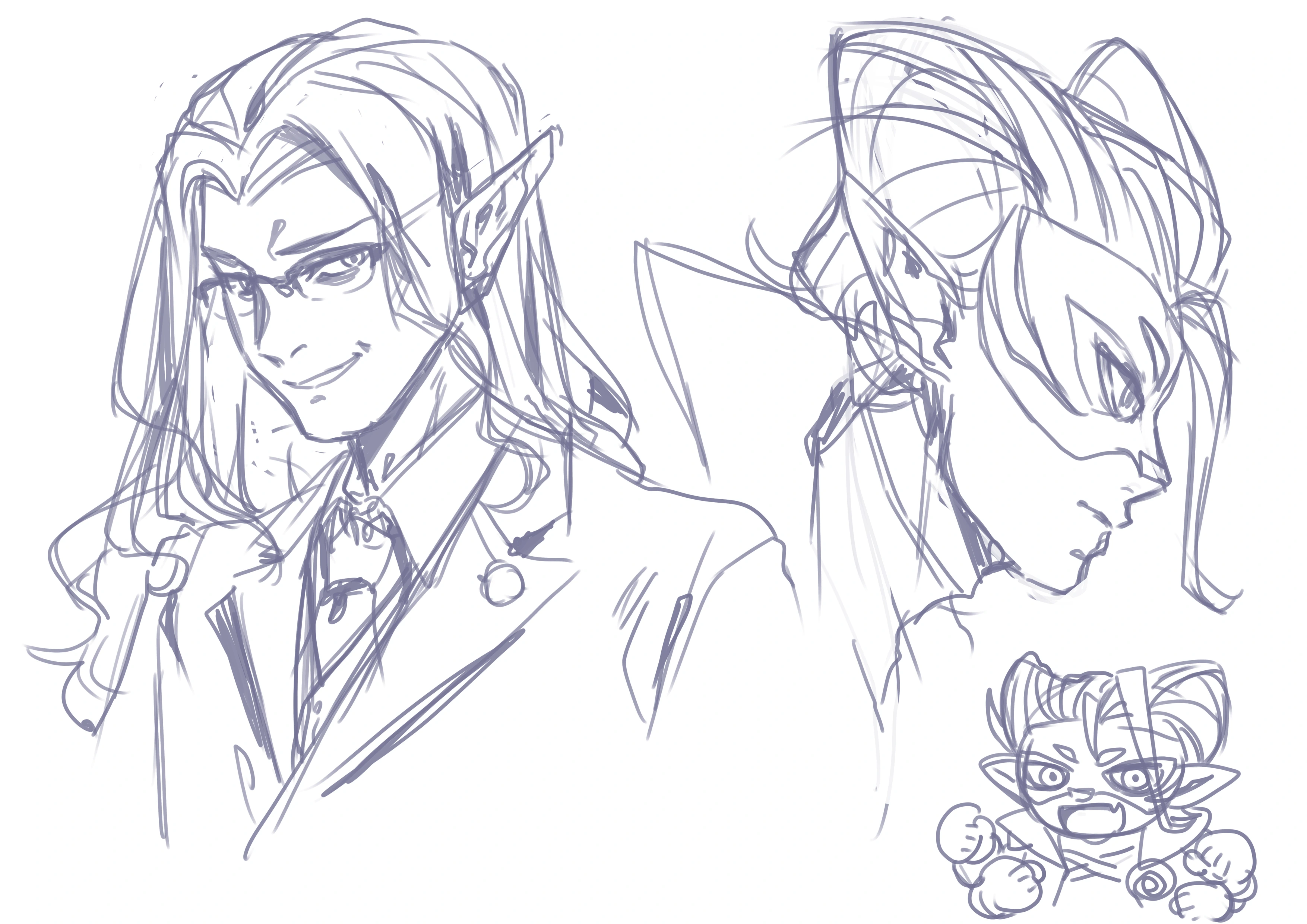
Profile sketches of Wampus by patrol_toroid/hisayoshi.
Lily, True Spirit Exile
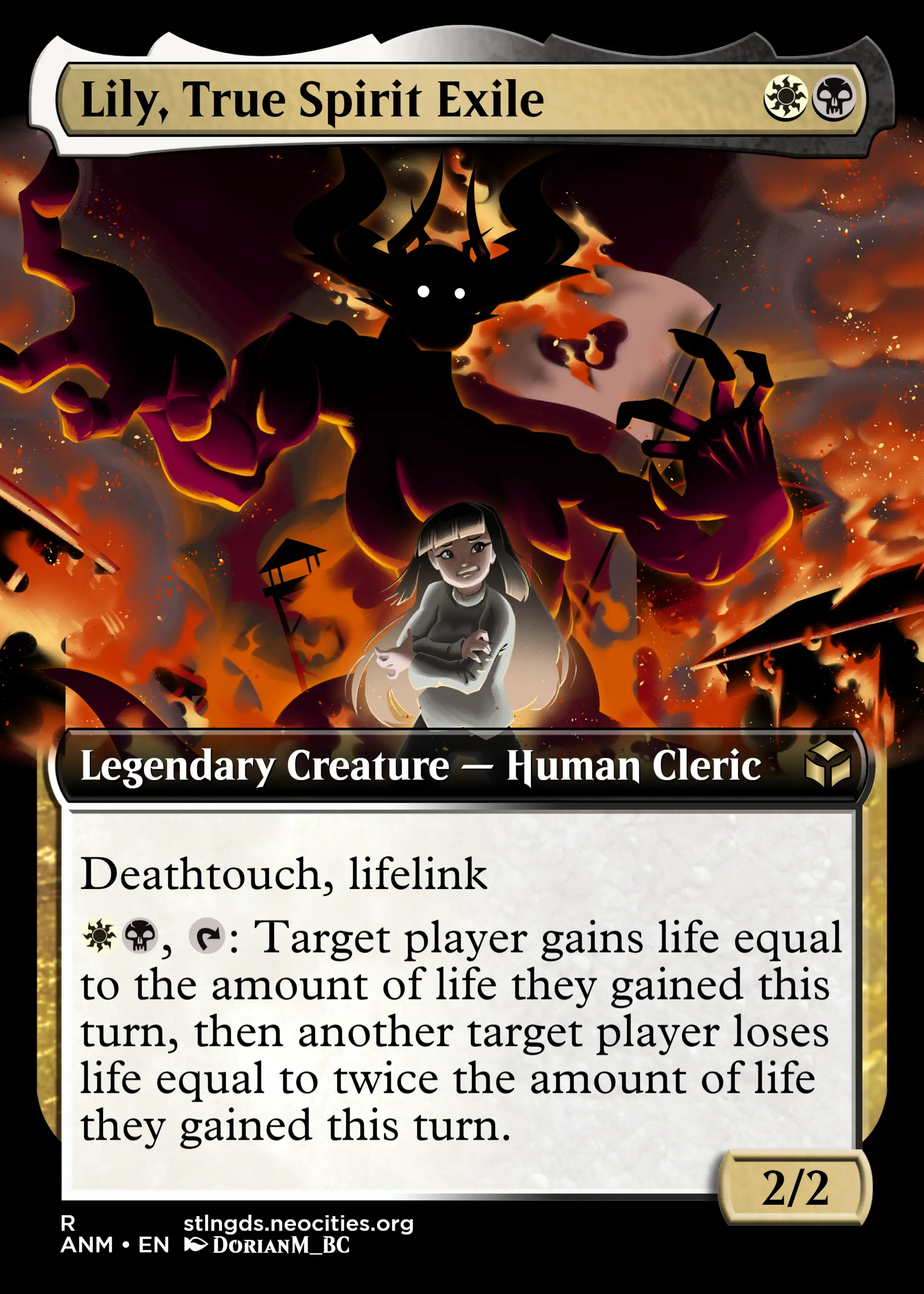
Next up, Lily is a young psychic and cleric who was indoctrinated into a cult - The Hands of the True Spirit - by her parents in her early teens. At this point in my creative exploration I was starting to seriously explore Belief As A Tool being a central mechanic of a magic system and where that could lead. Accordingly, the Hands are a zealous monotheistic cult that worships the True Spirit, a “god” of their own creation, forced into tangible existence through collective, fervent belief. Lily, in spite of this jealous god and cult, practiced her psychic abilities to serve her own means and in the process developed a headmate named Toshiro whom aided her explosive departure. I am still compelled by Lily and Toshiro’s characters, but knowing what I know now about Plurality and DID (and moreover, how much I still don’t know), I would really want to revisit them with that in mind before doing anything else with the two.
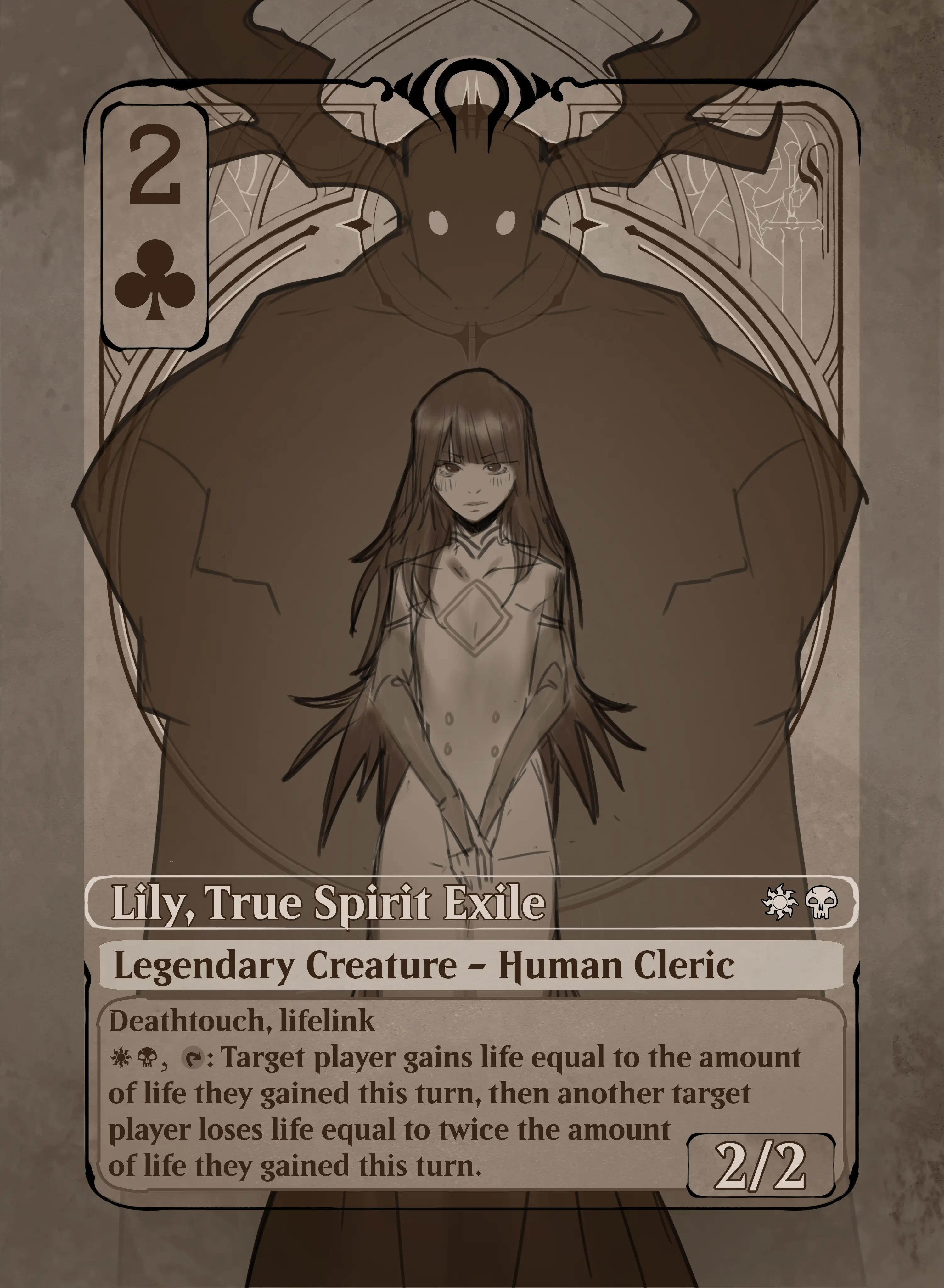
Standard 52-card deck variant, art and frame by .less.
Mechanically, she bears a stark resemblance to life doublers like Rhox Faithmender, and the niche-but-fascinating Tainted Remedy that encourages you to force your opponents to gain (but actually lose) life. Since she was designed, cards like Astarion, the Decadent have been printed that lean on this playstyle, but there are still scant few ways to force an opponent to gain life to their detriment (and that are easier than just dealing damage the normal way). I also noticed the potential to perform an untap combo with her, but given the activation costs of her ability, the difficulty in forcing lifegain on opponents in the first place, and Lily’s very blatant gameplan, I haven’t identified any scenarios where it’s actually a big problem.
Maisie, Prodigious Mind
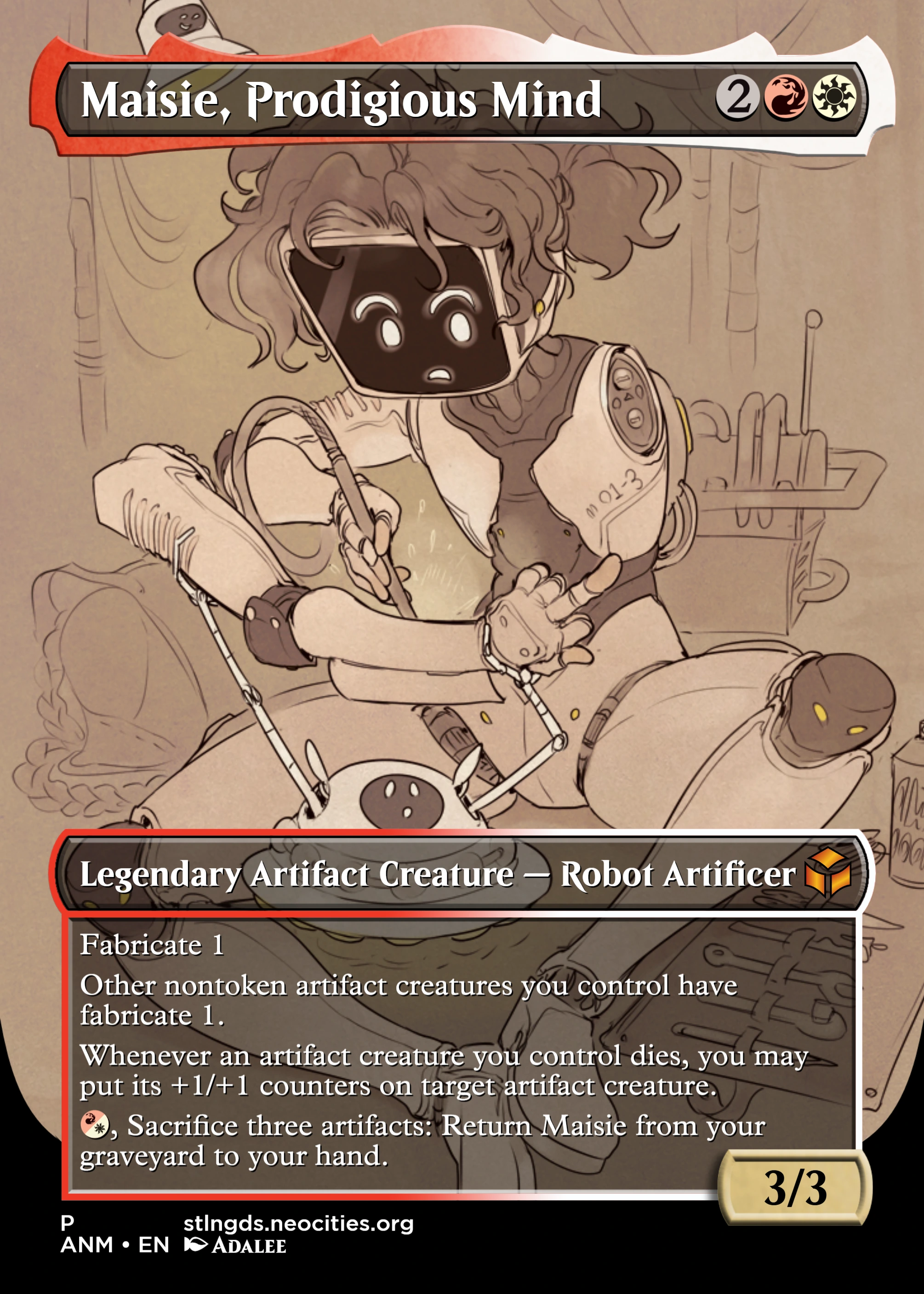
Maisie is a spin on Cayth, Famed Mechanist, giving up the proliferate and populate mechanics in favor of granting all your artifact creatures a beefed-up Fabricate 1 that’s actually Modular 1 in disguise. I imagine there are reasons why “everything gets modular” hasn’t been printed in Magic, though by 2025, modular is all but unplayed and the terrifying Affinity decks of yester-decade have been thoroughly kneecapped by bans and the passage of time. In the context of playing Maisie as a custom commander, and especially now that the Commander Brackets system exists, I can’t help but see Maisie (or any custom commander) interacting with something in some unforeseen way to be less of an issue with her, and more about managing expectations with your playgroup about the deck you built. Countless combos exist in Magic at varying degrees of speed and effectiveness, and at some point I think you can say “okay, this mechanic fundamentally combos with this other game piece and I can’t really change that about either, so at what cost and in what situation am I okay with the combo happening and how do I tweak the card accordingly?” Or even, “do I just not put the combo in this deck to target a lower Commander bracket?”
Ephemera the Ardent
.webp)
Ephemera was one of the first characters I ever designed, years and years ago. She was originally conceived as the protagonist of an abandoned Strategy RPG concept (the diminutive form of Ephemera being Effie, in reference to Fire Emblem), and elements from that concept still float around in her and all my other characters’ (and world) designs. She’s a powerful empath and psychic, and one of scant few characters able to walk between the folds of a magically-partitioned world, and so making her card a Planeswalker seemed obvious.
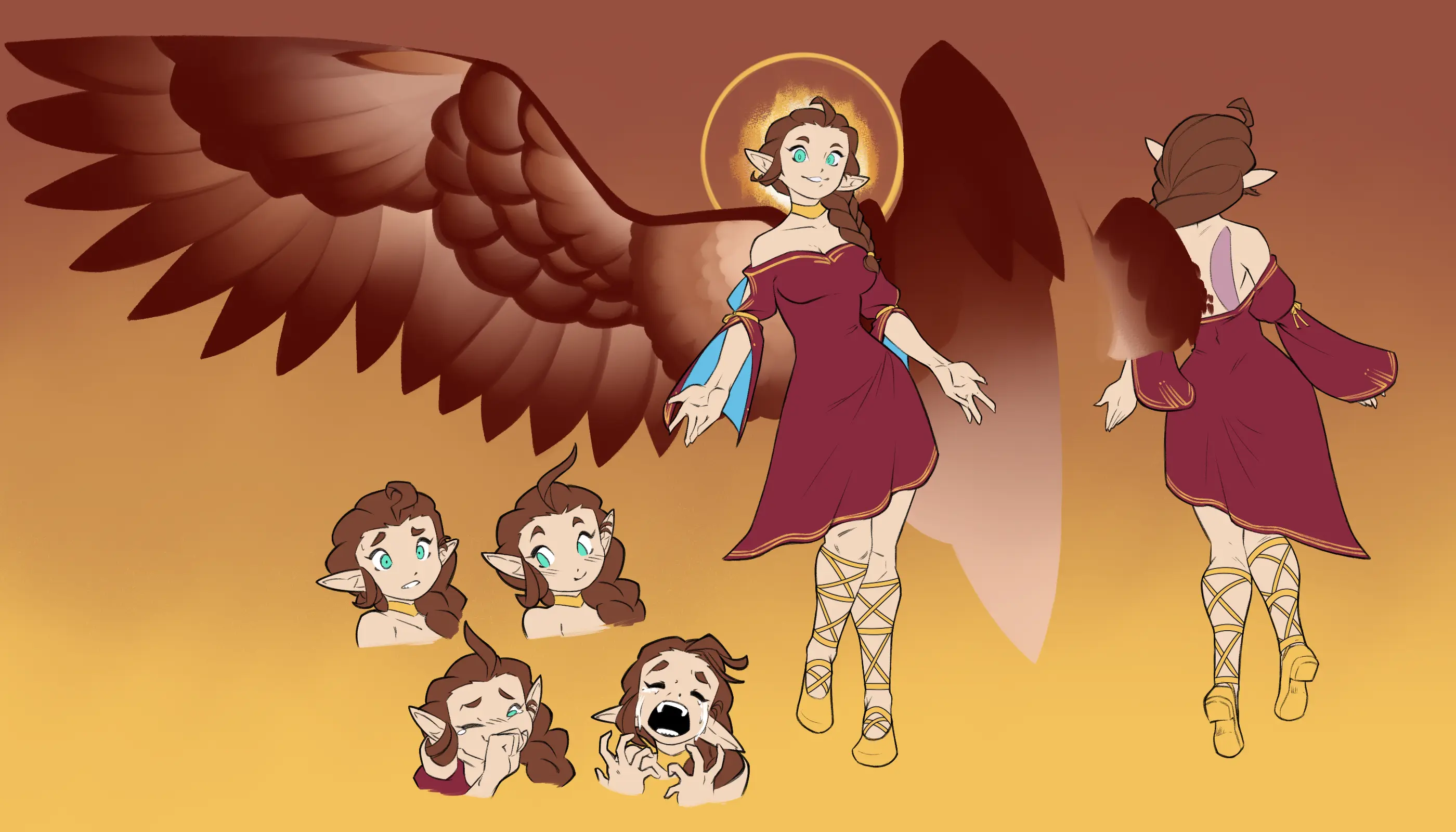
Effie reference sheet, art by Dorian.
Planeswalkers are bloody difficult to design and balance, and I don’t do them often. Magic R&D seems to agree nowadays, with most sets now around 0-2 planeswalkers. On top of that, as a hobbyist with only so much empirical playtesting data, I have markedly different design considerations and resources than if I were designing for, say, a Standard set or a preconstructed Commander deck.
With that in mind, this was designed around the time I was really into Vintage Cube and wanted to make cards that could enhance certain draft archetypes - in Ephemera’s case that was URW Spellslinger/Storm, which aims to cast a lot of spells in a single turn. This is mostly reflected in her +1 that scales with the number of spells you’ve cast (and the prowess mechanic which keeps the scaling going afterwards). For as high as the ceiling on it can get and as flavorful as it was with her original Fire Emblem-esque design and abilities, I think it was a big ask of these Storm decks to have a lot of creatures on top of maintaining a steady pace of spells to remain useful with Effie. As well, her -2 based on Angelic Arbiter can be critically disruptive and benefits from not being a static effect attached to a vulnerable creature, but in my experience performs much better in a slower Commander game where it can kneecap multiple opponents than it can in a fast-paced 1v1 Vintage draft game. As for her -7, it was meant to invoke “overwhelming and debilitating empathy”, which is a flavor win where her character is concerned, but has the same issue as the -2 where it’s wholly underwhelming against certain decks, especially in Vintage Cube.
I’m happy with the flavor of this card and how it translated to individual abilities, but they didn’t quite add up to the game piece I intended them to, making Effie of limited use to very specific kinds of decks rather than uplifting the archetypes in general like I wanted. I think her abilities are much better suited towards Commander gameplay, and were I to retool her in the future I would also take notes from Tarkir: Dragonstorm’s approach to URW go-wide spellslinger with Elsha, Threefold Master.
Empath’s Lament
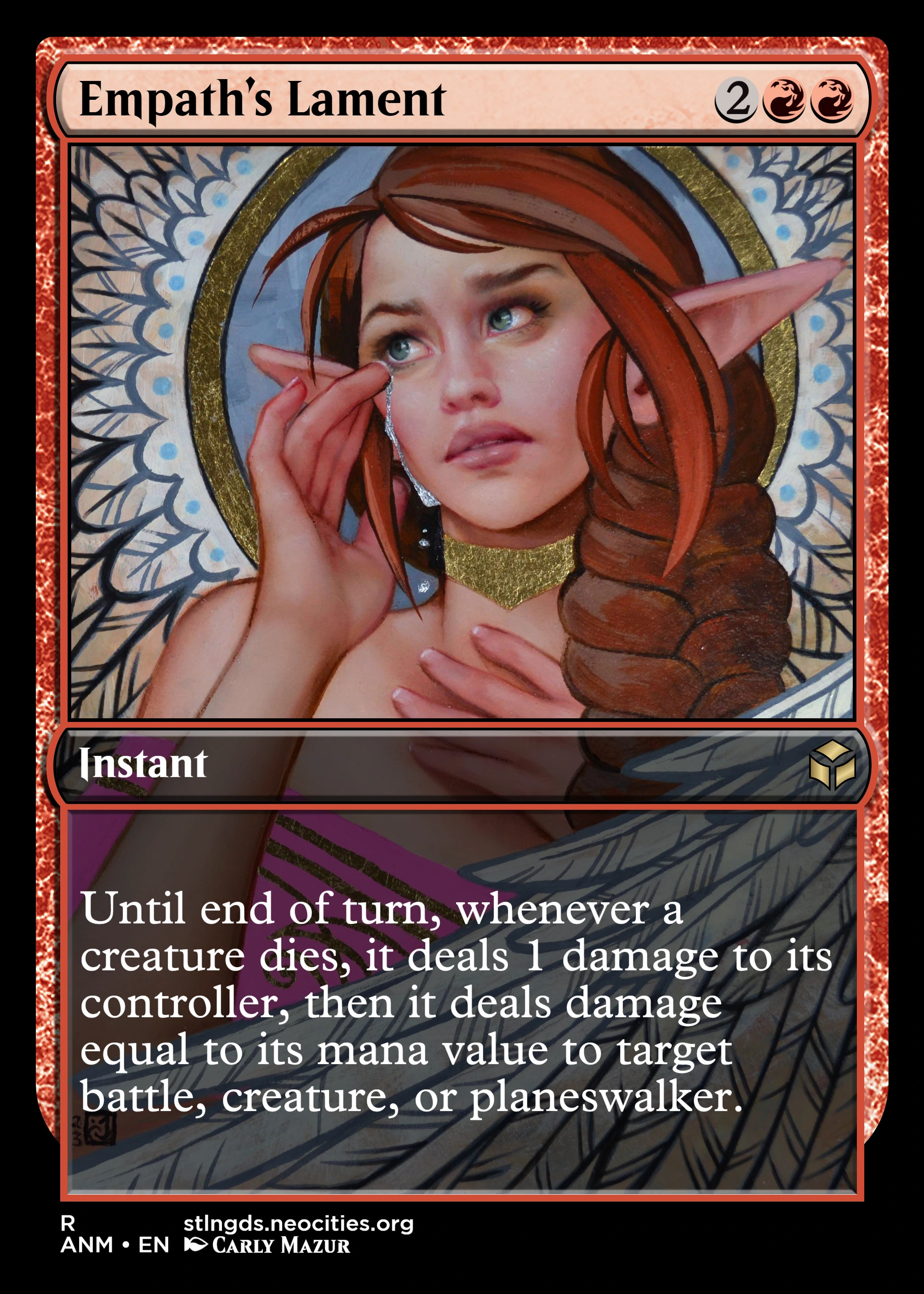
Discerning MTG fans might notice that this card’s artwork is by Magic art alum Carly Mazur. I won a charity auction for a custom, painted commission from her, and put it to use on this card! She did an amazing job!
Continuing with the idea of “overwhelming and debilitating empathy”, this is effectively a red riff on the likes of Grave Pact and Massacre Girl.
Guest Characters
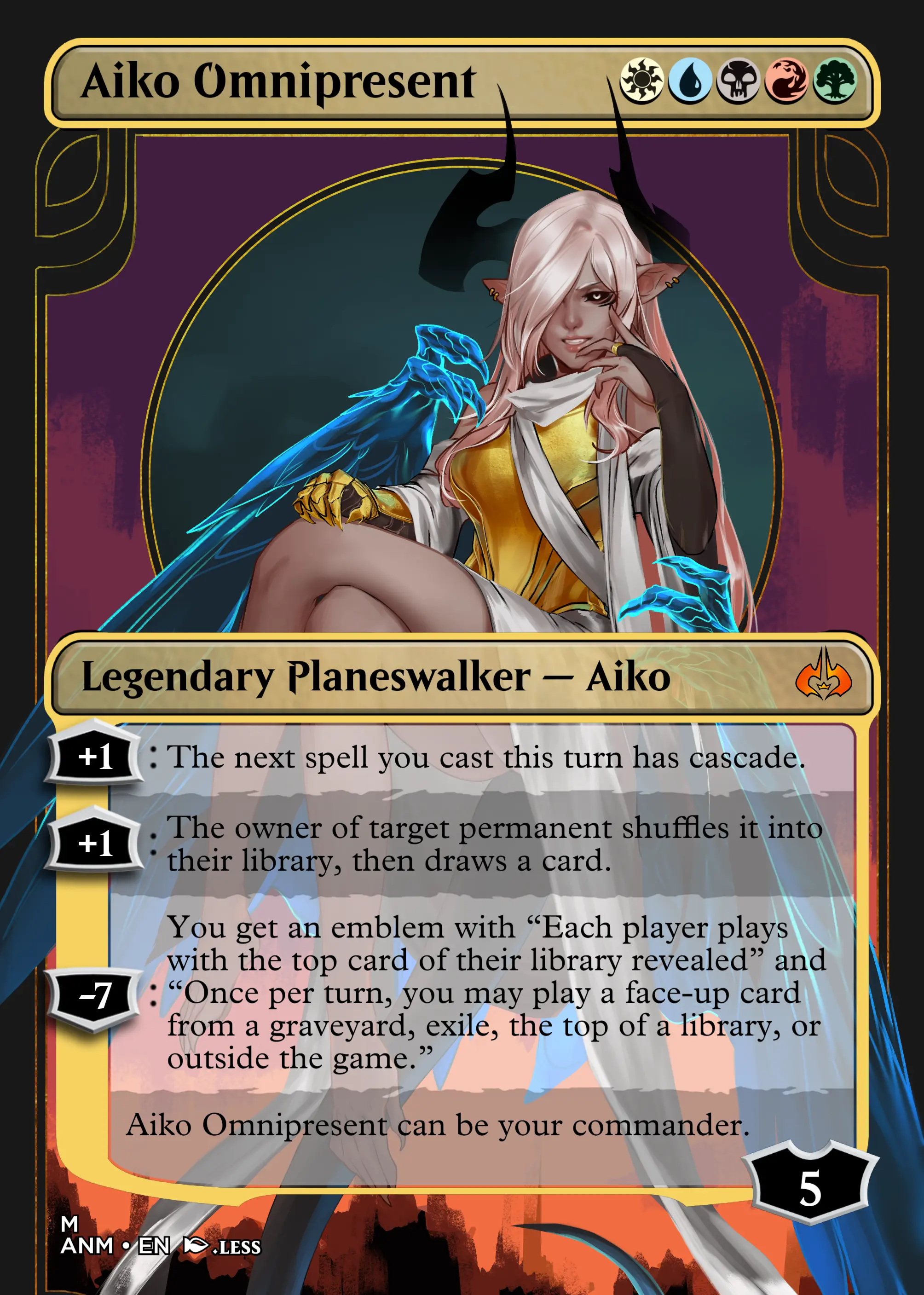
Aiko belongs to .less, the artist for this and the other cards in this section. She’s not directly related to any of my characters, but I put special effort and pride into this as .less and I have worked together for years now on cards and art beyond what is shown here. Also, this art is too good for the card not to also be thoughtfully designed.
Aiko is the half-angel, half-demon child of Haohi and Akai (pictured below), and inherited volatile and potent dimensional powers as a result. This card depicts her after some time spent maturing and learning how not to get lost from blindly planeswalking across the multiverse, similar to Magic’s own Wandering Emperor. Mechanically, I chose to represent this somewhat chaotic dimension warping with three effects: Cascade, Oblation, and her ultimate that acts as a souped-up version of Future Sight and allows you to pick through your opponents’ scraps.
I’m currently building a Commander deck with her that acts similar to the infamous Lantern Control decks of yore, though with much less of an emphasis on brutally locking down the game and more on manipulating topdecks to steal or capitalize on them in interesting ways. In that process, I’ve learned that there really aren’t that many ways to do that, which is bad news for me deckbuilding, but good news for my designer brain. While it’s still very much a work in progress on both a design and deckbuilding front, I would eventually like to expand the concept into a full mock-preconstructed Commander deck with about 10-12 new cards that aid the deck’s unusual and otherwise unsupported strategy, including Aiko.
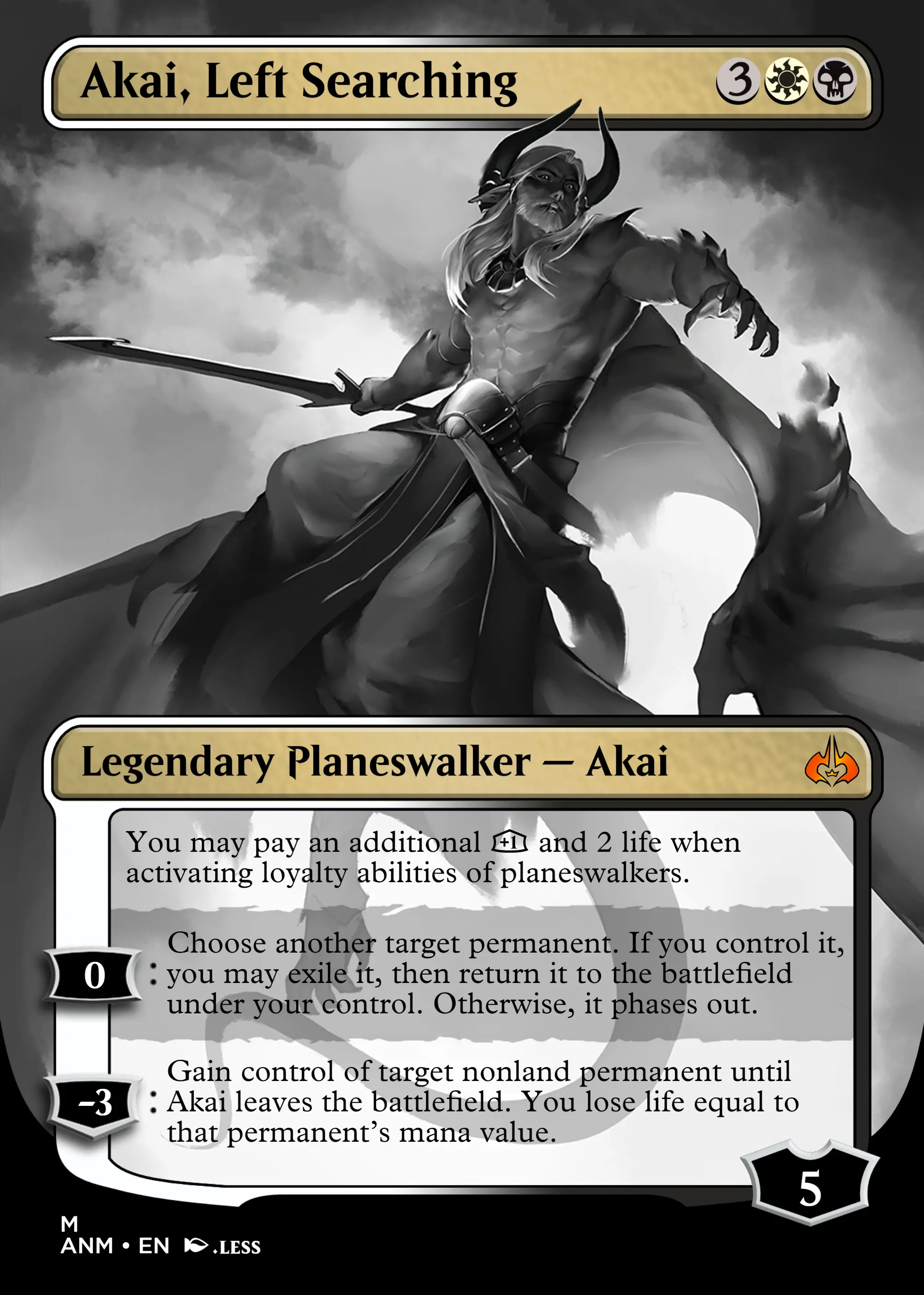
Akai - demonic patriarch, interplanar aspirant, and father to Aiko.
Another of my favorite designs that I think encapsulates some really interesting aspects of white and black planeswalkers, while also leaning into Akai’s character a lot. 2 life for 1 loyalty is a fairly steep cost, but one that the most ambitious planeswalker decks will happily pay (and that I enjoy making them pay and plan around). His -3 is an atypical theft effect not usually seen in WB, but that I think fits quite well - black is tertiary in theft effects and gets them based on common black costs like paying life, while white makes it additionally conditional on Akai’s continued presence. That might seem like a lot of hoops, but Akai’s 0 ability allows you to exile a stolen permanent and return it under your control - permanently, without Akai needing to be there. This is, of course, on top of all the other obvious utility his 0 has. I’m very happy with how this design came together.
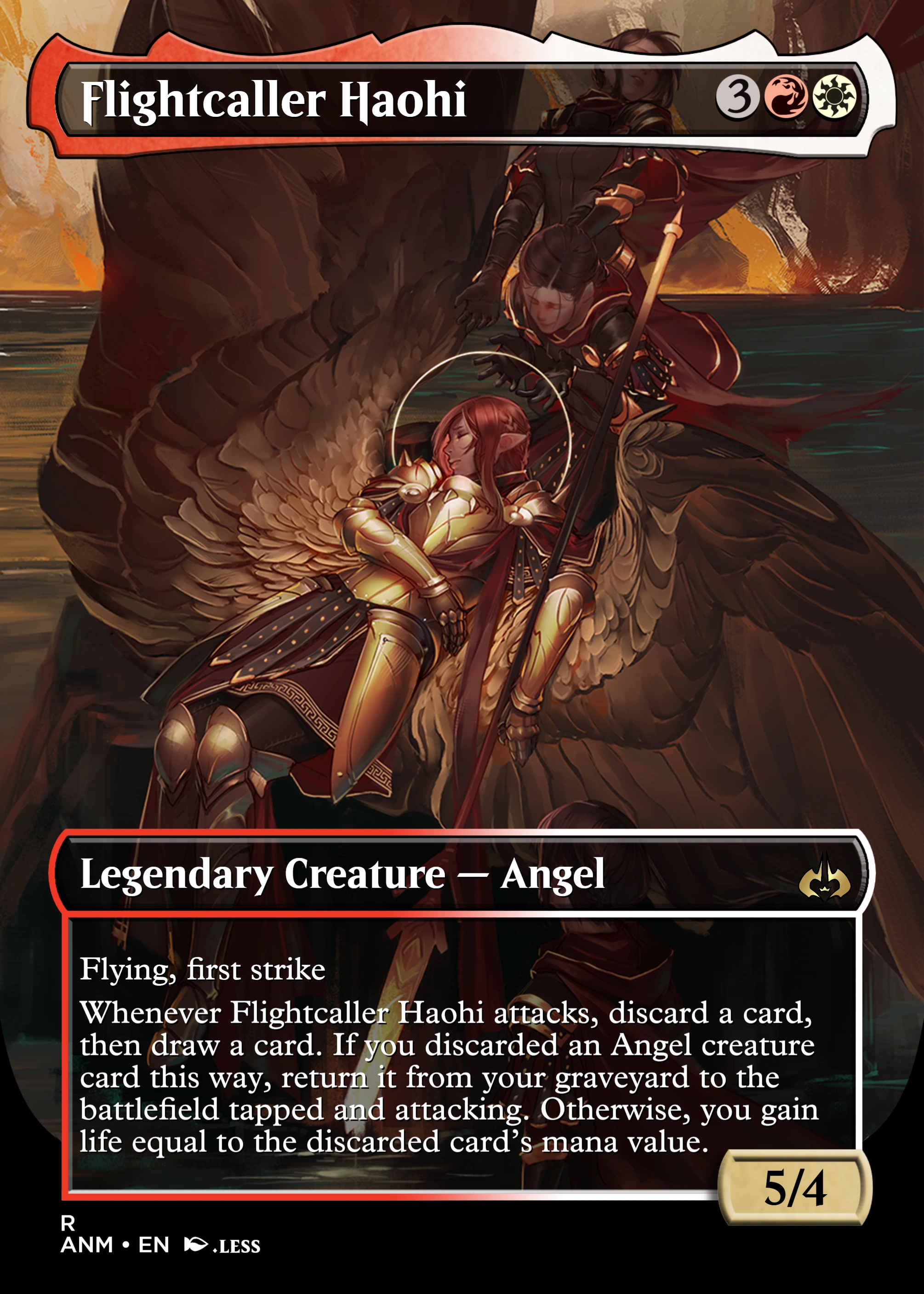
Haohi - exiled flightcaller, the primordial flame, and mother to Aiko.
Haohi’s design was largely top-down but also arose from a not-so-hidden desire for a Kaalia of the Vast effect specific to Angels that both differentiated itself from Kaalia enough to be relevant and interesting, but wouldn’t draw quite as much ire as Kaalia infamously does. To that end, simply removing black from her color identity, limiting her to Angels, and increasing her cost to 5 mana does a lot of heavy lifting to make Haohi less of an flashing neon sign saying that everyone should kill you first. To make her still have some relevance over Kaalia, though, I decided to also have Haohi discard then draw (a challenge for any Angel deck), and gain life if it’s not an Angel. I feel the pull to continue iterating on this card, but I think it’s in a pretty solid spot as it is.
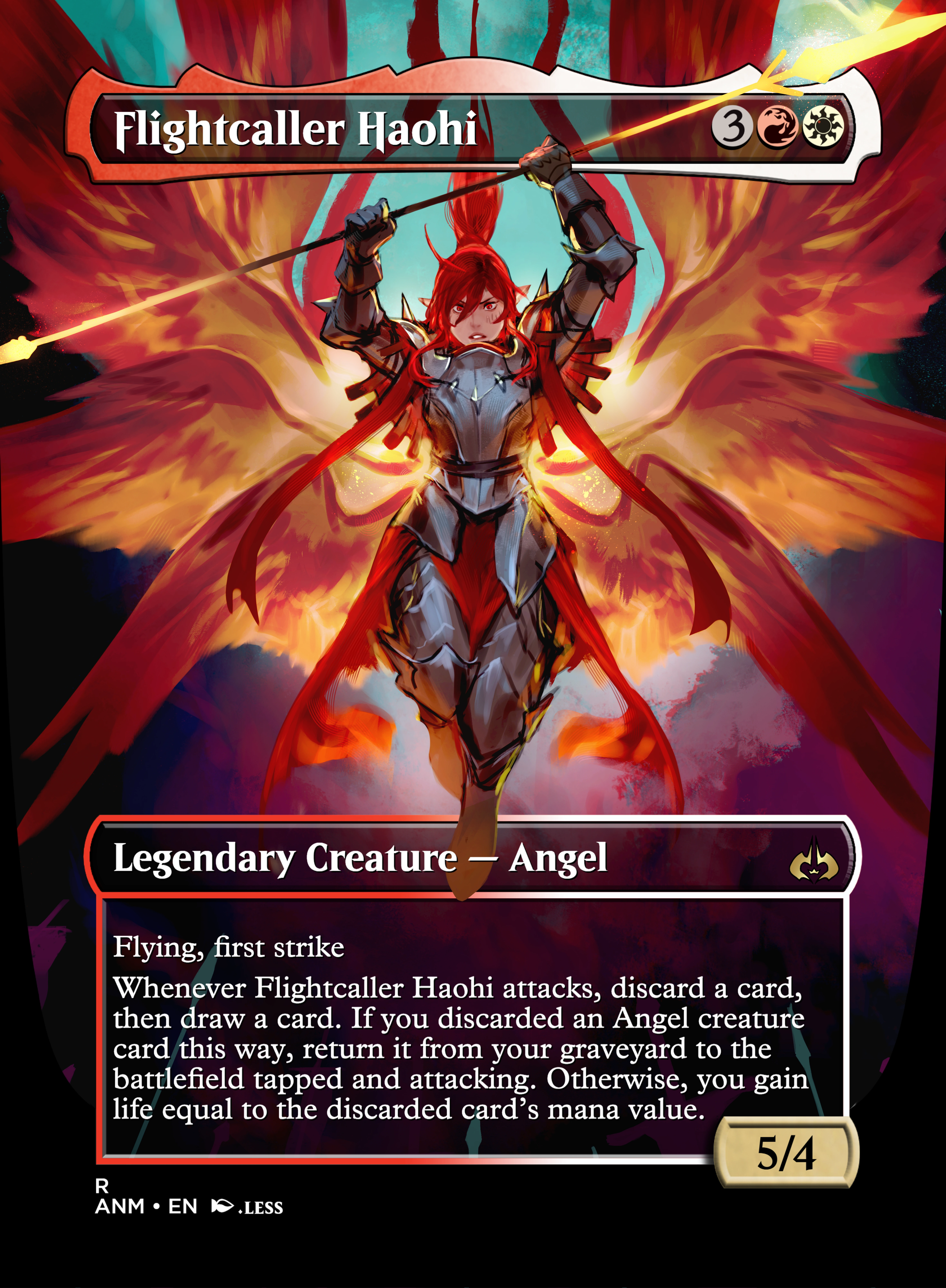
Haohi "framebreak" alternate art, with art elements overlaid on the card frame. This image shows the extra 1/8th inch bleed edges needed for printing.
Grace, Marsupial Mechanist
.webp)
It’s me! I want you to cast artifacts a lot, and during your opponents’ turns! If you’ve met me in-person, I might have given you a business card with this on it!
Death Knell
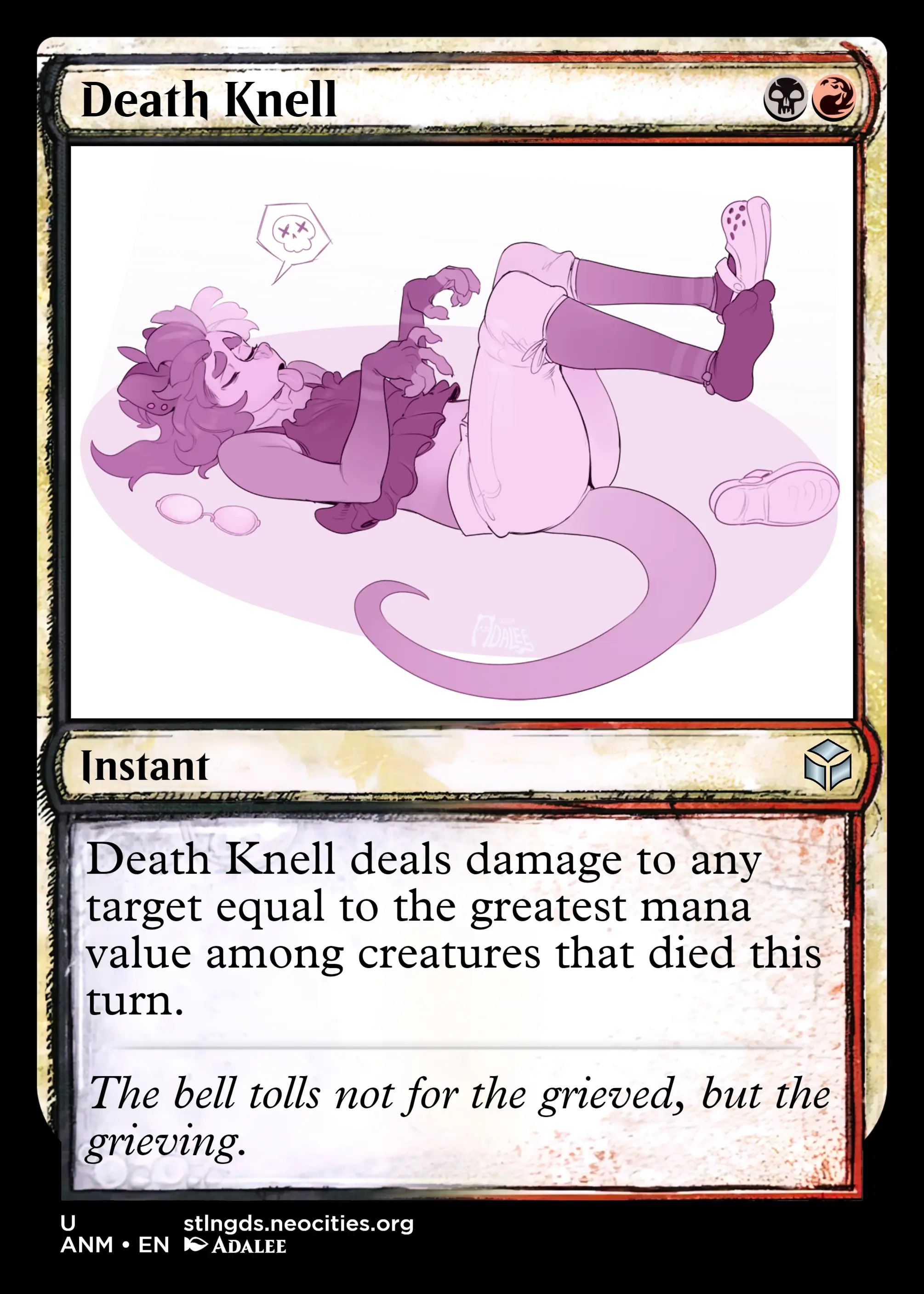
And that’s my time! You’ll undoubtedly hear me yap about Magic more later, but if you’re itching for more, you can check out my other articles, or find my card and art archive here!